Portfolio · 2024
In the Shape of a Home
for vocal sextet
Written for Ekmeles
Materials
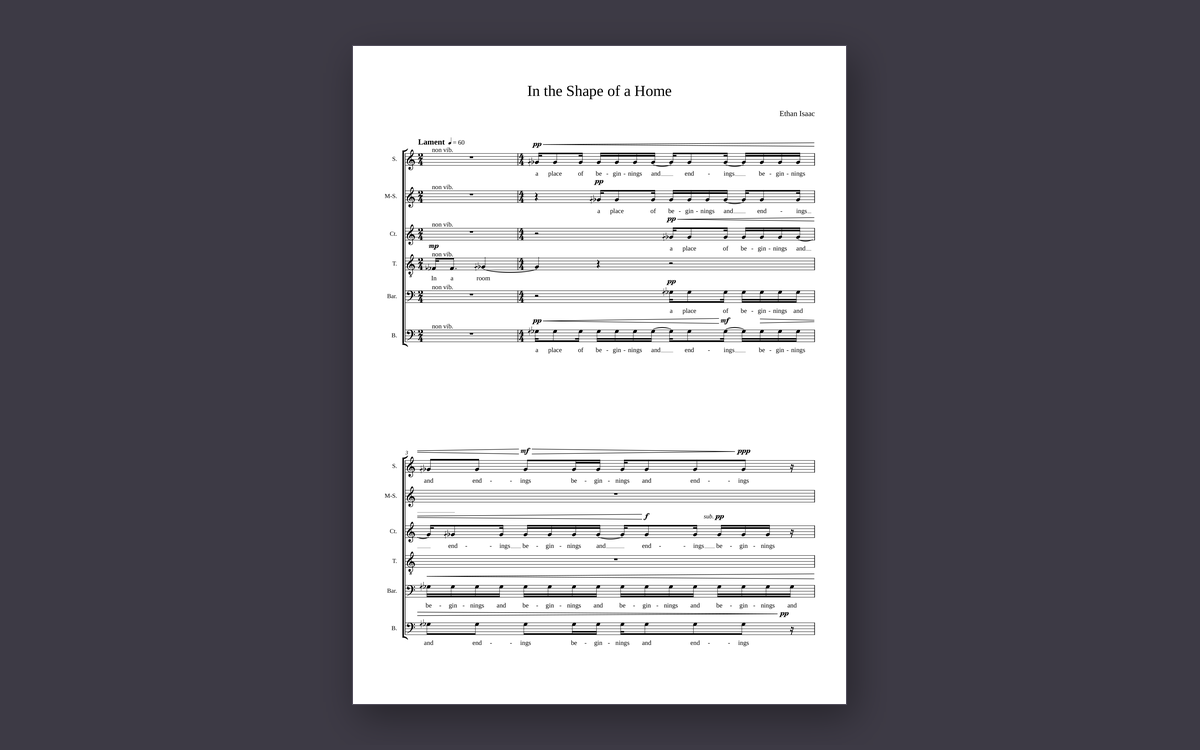
In the Shape of a Home is a nine-minute work for vocal sextet in just intonation, written for Ekmeles and the compositional companion to my master’s thesis of the same name — In the Shape of a Home: Balancing Harry Partch’s Corporeality and Abstraction in Just Intonation Music, presented at AMS/SMT in Minneapolis. The piece sets out a method for reconciling Partch’s foundational dichotomy: scales are derived from polyphonic spectral analysis of specific physical rooms, then realised through Extended Helmholtz-Ellis just intonation. Each formal section is built around a room whose tuning is an acoustic echo of that space, while interstitial Mysteries and a closing Porch move toward Abstraction through non-spectrally derived pitches and melismatic writing.
Program Note
The work proposes a synthesis between Spectralism and American just intonation — two practices that share an interest in harmonically derived structure but have traditionally remained apart. Partch’s Corporeality insists that music be grounded in physical bodies, voice, and dramatic context, and warns against disembodied Abstraction. The thesis takes a core Spectralist technique — analysing physical spaces via spectrogram and deriving scales from the acoustic resonances of those specific environments — and uses it to provide an additional empirical basis for Corporeality. That methodology, integrated with the extended just intonation system Ben Johnston built on top of Partch’s, gives the work its tuning vocabulary.
The piece’s formal sections employ scales closely aligned with the acoustic data retrieved from rooms, as a direct physical analogue to Corporeality. Sections such as the Porch and the interstitial Mysteries move the other way, introducing non-spectrally derived pitch collections, tonal relationships, and melismatic textures that lift away from Corporeality’s emphasis on dramatic speech rhythm. The dramatic trajectory mirrors a narrative progression from material to spiritual. The argument the work makes is that Corporeality and Abstraction can function in unison, rather than in contradiction, within a sufficiently flexible theoretical frame.
In memoriam
The poem below was read at my grandfather’s funeral. It is not incorporated into the work.
On Children
Your children are not your children.
They are the sons and daughters of Life’s longing for itself.
They come through you but not from you,
And though they are with you yet they belong not to you.You may give them your love but not your thoughts,
For they have their own thoughts.
You may house their bodies but not their souls,
For their souls dwell in the house of tomorrow, which you cannot visit, not even in your dreams.
You may strive to be like them, but seek not to make them like you.
For life goes not backward nor tarries with yesterday.
You are the bows from which your children as living arrows are sent forth.
The archer sees the mark upon the path of the infinite, and He bends you with His might that His arrows may go swift and far.
Let your bending in the archer’s hand be for gladness;
For even as He loves the arrow that flies, so He loves also the bow that is stable.— Kahlil Gibran
Related research
- Queerness in Harry Partch's Corporeality: Margins, Hobos, and Embodied Aesthetics · Conference Paper
- In the Shape of a Home: Balancing Harry Partch's Corporeality and Abstraction in Just Intonation Music · Conference Paper
- In the Shape of a Home: Balancing Harry Partch's Corporeality and Abstraction in Just Intonation Music · thesis